So, I’m not officially diagnosed but I match a lot of autism traits, and lately I’m trying to understand myself better. For a long time I only focused on the hard parts — like social stuff, getting tired fast, or feeling misunderstood. But yesterday something strange happened. I was doing this small hobby of mine, very focused, and I felt… actually good. Calm, comfortable, kinda “in my own world” but in a nice way.
And I thought, maybe autism is not always only struggle. Maybe sometimes it gives us moments where we feel safe, focused, or happy in our own way.
So I wanted to ask:
Is it normal to feel good with autism sometimes?
Like, having moments where you feel more yourself, or where your brain actually helps you instead of fighting you?
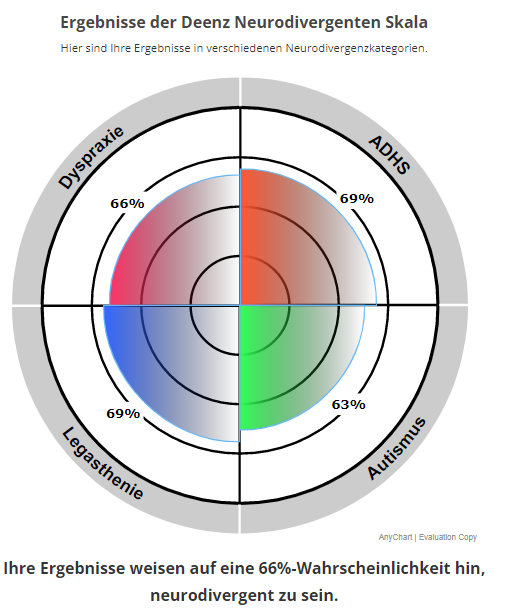
Also, if anyone is curious, I found a simple self-assessment (English + German versions) that helped me understand my traits a bit better — not a diagnosis, just a self-screening: Neurodivergent Test - Am I Neurodivergent
Yes, I think feeling good with autism (or ADHD) sometimes is quite normal.
One aspect might be the so called hyperfocus, wich means to be focussed on something very intensely. I think this goes hand in hand with the good feeling of doing exactly the right thing.
Another example is an emergency situation involving ADHD. If, for example, in a car accident, everyone around becomes stressed (dopamine and norepinephrine levels rise, the PFC comes under pressure), this acute increase in dopamine and norepinephrine compensates for the deficiency that otherwise exists in ADHD, and everything functions with a clear head and overview that everyone else is currently lacking. In an accident or emergency situation, it can be helpful to have someone with ADHD around. It is no coincidence that the rate of ADHD is significantly higher among paramedics and emergency doctors. However, these are exceptional situations, the frequency of which can perhaps be influenced (choice of profession). But it would be a fallacy to believe that autism and ADHD simply need the right environment and then everything will be fine. Anyone who claims this should please create such an environment.
Expanding on the Emergency Situation in which some people lose their ability to focus and higher order brain function seems to be lost when they are in shock or under very high stress. In the general case mostly.
[This is a high level very basic understanding, off the top of my head, which may need work on some of the details. But, the general idea is there.
There is a throttle in our brains for prefrontal cortex activity. HCN (Hyperpolarization-activated Cyclic Nucleotide-gated) channels and KCNQ (voltage-gated potassium channels, subtype Q). When the channels open, potassium ions flow out and sodium ions flow in. Which has the effect of blocking signalling. Some theory expresses that at the more extreme end, it is a way to hold back higher order thinking and make the brain in fight or flight situations use the instincts from the brain stem. But, those channels in daily life also act as a throttle for PFC activity.
HCN and KCNQ channels are opened when Cyclic Adenosine Monophosphate (cAMP) activates Protein Kinase A (PKA), which activates the receptors that open the channels. Now, the interesting thing is Norepinephrine (NE), which one of its functions is as an Alpha2a Adrenergic agonist (triggers the receptors) that are located on certain cells with HCN and KCNQ channels in the PFC.
Activating the alpha2a receptors there blocks Adenylyl Cyclases which prevents ATP conversion to cAMP. Which prevents PKA activation and results in HCN and KCNQ channels closing. And when closed, increases efficiency of neuronal signalling in the PFC. Alpha2a also acts as an NE autoreceptor, and tells the cell to release less NE (feedback loop that regulates balance). In which guanfacine, is a selective Alpha2a - Adrenergic agonist like NE, but much stronger at it. Which is how it provides its therapeutic benefit for ADHD. By increasing overall signalling efficiency in the PFC where the higher order functioning is aided.
There are other areas and different HCN subtypes and all kinds of lower level details. But, the general idea is all I am trying to convey here. Can easily look into more details. Just note that different sources go into different amounts of detail which can be confusing itself.
On another aspect. You presented info that is new to me in regards to extremes. I have no idea if this article I link is in line with your sources of info, or may be unrelated.
This linked article does show that for ADHD, sometimes pressure can be a motivator and increase performance. But does not mention at the extreme levels you indicated if I recall correctly. Maybe the mechanism rings a bell with what you know or is a separate aspect at pressures of everyday life.